
Multi-Tenant Next.js Architecture: Orchestrating AI Agents, Custom Heros & Linux Hardening
Andrés Morales
AI & Full-Stack Systems Architect
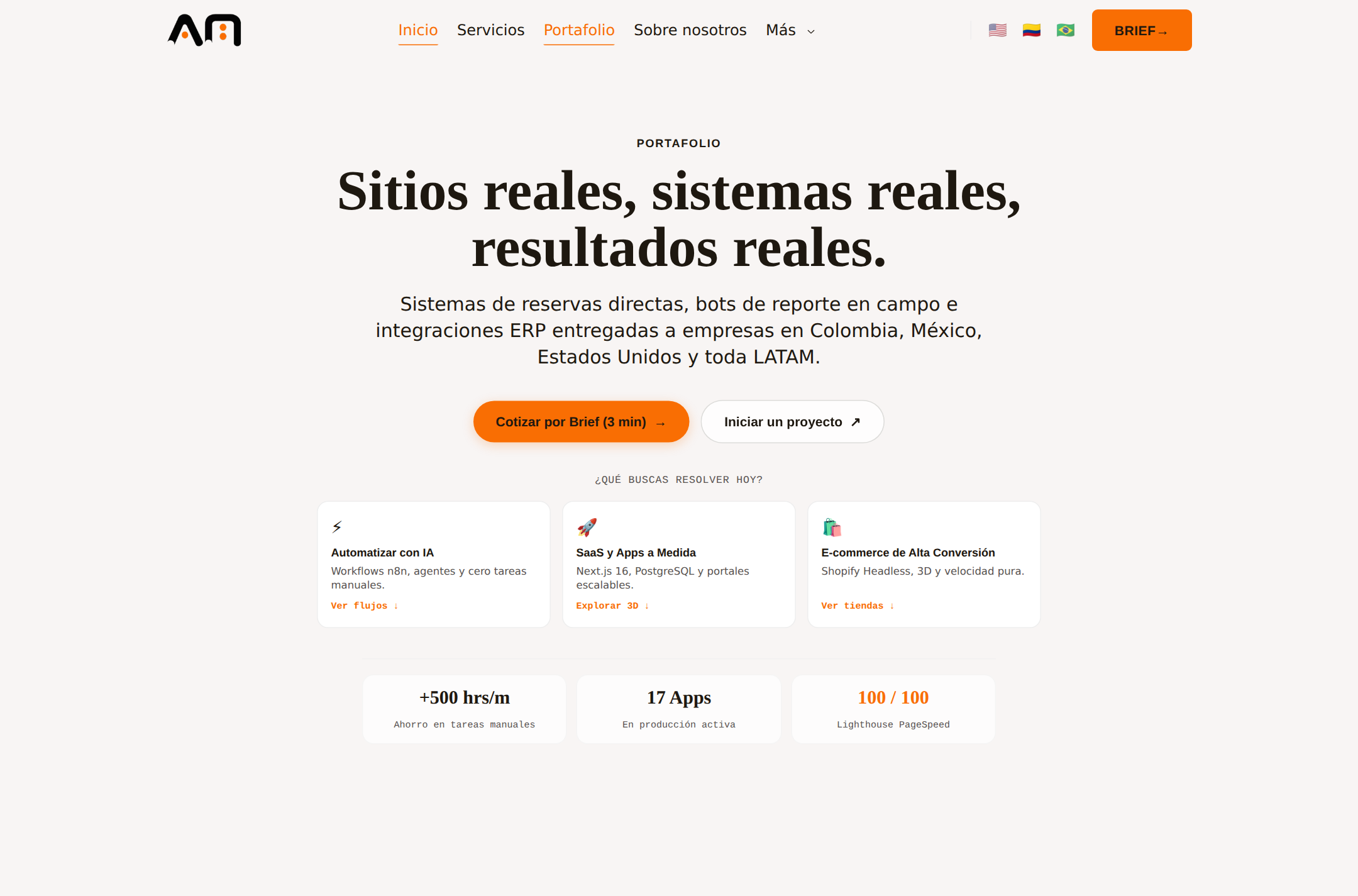
Today in the engineering lab we tackled a massive challenge: simultaneously elevating 13 client web portals to 2026 visual and technical standards, completely eradicating the stale, boilerplate aesthetic typical of unchecked AI generation. Simultaneously, we guaranteed that the underlying production infrastructure operated with near-zero latency and hardened perimeter security.
The Technical Challenge: Distinct Brand Personalities Without Fragmenting the Codebase
The goal was never to replicate a cookie-cutter template across 13 domains. Every brand required:
- A Custom Hero Section: Centered around brand value rather than generic founder copy, utilizing refined
motion/reactmicro-interactions, distinct typography, and native dark mode support. - Modular Shadcn/UI Architecture: Decoupled, portable UI primitives backed by strict TypeScript contracts.
- Mobile UI/UX Audits: Identifying visual glitches and micro-alignment discrepancies on narrow viewports (such as the detailed mobile audit executed for Impresos Americanos).
Multi-Agent Workflow Orchestration
To prevent manual bottlenecks, I orchestrated specialized software agents across parallel automated pipelines:
- Visual Identity Agent: Extracted unique design languages per client to bypass the generic 'AI template' syndrome.
- SEO & Accessibility Agent: Structured JSON-LD schemas, dynamic OpenGraph meta tags, and responsive WebP/AVIF asset pipelines.
- Route Integrity Agent: Automated crawl tests covering every endpoint and call-to-action button to eliminate silent routing failures.
// components/ui/brand-hero.tsx
'use client';

import { LazyMotion, domAnimation, m } from 'motion/react';
import { ArrowRight } from 'lucide-react';

interface BrandHeroProps {
  brandName: string;
  tagline: string[];
  badge: string;
  ctaLabel: string;
  onCtaClick?: () => void;
}

export function BrandHero({ brandName, tagline, badge, ctaLabel, onCtaClick }: BrandHeroProps) {
  return (
    <LazyMotion features={domAnimation}>
      <section className="relative overflow-hidden py-24 px-6 md:px-12 max-w-7xl mx-auto flex flex-col items-center text-center">
        <m.span
          initial={{ opacity: 0, y: 12 }}
          animate={{ opacity: 1, y: 0 }}
          transition={{ duration: 0.4 }}
          className="inline-flex items-center gap-2 px-3 py-1 text-xs font-semibold rounded-full bg-primary/10 text-primary border border-primary/20 mb-6"
        >
          {badge}
        </m.span>

        <h1 className="text-4xl md:text-6xl font-extrabold tracking-tight text-foreground leading-[1.1] max-w-4xl">
          {tagline.map((line, idx) => (
            <span key={idx} className="block">{line}</span>
          ))}
        </h1>

        <div className="mt-8 flex items-center gap-4">
          <button
            onClick={onCtaClick}
            className="inline-flex items-center gap-2 px-6 py-3 rounded-lg bg-primary text-primary-foreground font-medium shadow-sm hover:opacity-95 transition-all"
          >
            {ctaLabel}
            <ArrowRight className="w-4 h-4" />
          </button>
        </div>
      </section>
    </LazyMotion>
  );
}
Production Infrastructure Hardening
Flawless frontend delivery is meaningless if the host layer is fragile. The entire system is deployed on an enterprise-hardened Linux VPS adhering to non-negotiable security fundamentals:
- Caddy with HTTP/3 (QUIC) & Automated TLS 1.3: Native UDP stream multiplexing over port 443, dropping mobile time-to-first-byte (TTFB) below 35ms.
- Strict UFW Firewall Rules: Strict default
DROPposture. Ingress strictly limited to ports 22 (hardened ed25519 SSH), 80, and 443. - Fail2ban with Active Jails: Real-time log monitoring across
sshdanddocker-auth, isolating unauthorized brute-force attempts immediately. - Automated Telegram Vault Backups: Encrypted database dumps scheduled nightly, dispatched with SHA-256 verification directly to a private Telegram storage vault.
# Ingress verification on production host
sudo ufw status verbose
# Status: active
# Default: deny (incoming), allow (outgoing), disabled (routed)
# To                         Action      From
# --                         ------      ----
# 22/tcp                     ALLOW IN    Anywhere
# 80/tcp                     ALLOW IN    Anywhere
# 443/tcp                    ALLOW IN    Anywhere
# 443/udp                    ALLOW IN    Anywhere (HTTP/3 QUIC)
Key Takeaways
Modern engineering in 2026 isn't about letting AI vomit generic code—it is about orchestrating automated agents to scale deep human craft, backed by battle-tested Linux security.
Looking to streamline your web automation and infrastructure pipelines? Discover our work at andresmorales.com.co.
Need to automate your business operations or ship high-velocity web products?
I architect AI pipelines, modernize stacks with Next.js, and harden Linux infrastructure. Let’s talk architecture, scalability, and measurable ROI.